

Dyne test: how to check that your parts are properly degreased
Paint that peels, an adhesive that lets go, a seal that leaks: very often the cause is an invisible film of oil left on the part. Dyne test inks and dyne pens, a surface tension test, are the quickest way to check parts degreasing on the shop floor. This guide explains how to use them on metal parts, which value each application needs and which washing technology reaches it.
How to perform a dyne test
- Test at room temperature, on a dry part, shortly after washing: a surface can be recontaminated by handling or storage.
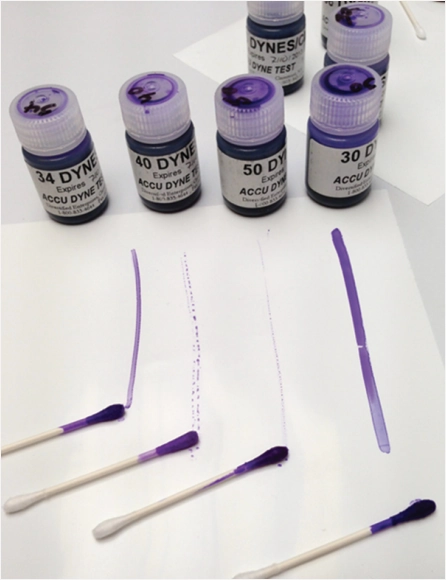
- Start with the ink of your target value. Draw a line of about 10 cm with a clean swab or the pen tip.
- Watch the line for 2 to 3 seconds. If it stays continuous, the surface reaches at least that value. If it breaks into droplets, it does not.
- To find the actual level, continue with the next higher ink (if it passed) or the next lower one (if it failed).
- Test several points, including critical areas: internal diameters, sealing faces, bonding areas.
- Use a new swab for each test and keep inks closed; contaminated or old inks give wrong results. Their typical shelf life is about 12 months.
Why surface energy matters
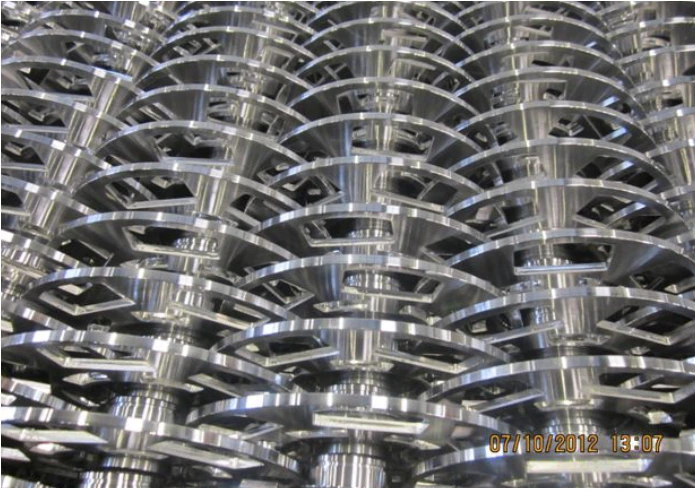
A liquid spreads on a surface only if the surface energy of the part is higher than the surface tension of the liquid. A clean metal surface has a high surface energy: paint, adhesive or sealant wets it and adheres. A thin film of oil, coolant, release agent or residual surfactant lowers that energy, the liquid beads up and adhesion fails, even when the part looks clean.
- Paint and powder coating: blistering, craters, peeling.
- Bonding and sealing: weak bonds, leaks found at the leak test.
- Coatings and surface treatments (PVD, plating, heat treatment): stains, poor adhesion, rejects.
- Welding and brazing: porosity and inconsistent joints.
Which dyne level for which application?
Indicative values commonly found in metal parts specifications. The value on your drawing or in your customer specification always prevails.
| Dyne level | Typical applications | Washing technology |
|---|---|---|
| 34 dyn/cm | Washing between machining operations, cleaning before assembly or storage | Water-based washing, rinse optional |
| 36 dyn/cm | Solvent-based paint, general coating, welding | Water-based washing, rinse optional |
| 38 dyn/cm | Powder coating, water-based paint, bonding and sealing, leak-tight assemblies | Water-based washing with rinse, or vacuum solvent |
| 40 dyn/cm | Structural bonding, plating, heat treatment (nitriding, carburizing) | Water-based washing with rinse, or vacuum solvent |
| 42 dyn/cm + | PVD and thin coatings, vacuum brazing, medical and electronic parts | Vacuum solvent |
How to reach your dyne value
Spray washing: up to 38 dyn/cm
WashTech spray washers (aqueous detergent) reach up to 38 dyn/cm when these points are under control:
- Chemistry: a detergent suited to the oil (neat oil, emulsion, wax) and kept at the right concentration.
- Temperature and spray pressure: enough mechanical action to reach every surface, including holes and internal diameters.
- Rinsing: optional up to 36 dyn/cm, essential from 38 dyn/cm: detergent residues lower the surface energy too.
- Drying: water marks and slow drying leave residues and invite recontamination.
- Bath maintenance: filtration and oil separation keep the result stable from one batch to the next.
The MecanoFAST washes, rinses and dries each part in the robot cell. See all our industrial parts washers.
Vacuum solvent: 40 to 42 dyn/cm
Beyond 38 dyn/cm, or with difficult oils (neat cutting oils, waxes, preservation oils), vacuum solvent degreasing (Solvacs machines) is the solution: the solvent dissolves the oil instead of emulsifying it, is distilled continuously and leaves no detergent residue. Parts come out dry, with a surface energy up to 42 dyn/cm.
Dyne inks, contact angle or water break test?
| Method | What it shows | Where it fits |
|---|---|---|
| Dyne test inks | Whether the surface reaches a given energy level, in dyn/cm | Shop floor, incoming and final inspection |
| Contact angle (goniometer) | Precise surface energy from the angle of a liquid drop | Laboratory, process validation |
| Water break test | Whether a film of water stays continuous on the surface | Quick go / no-go check on metal |
| ISO 16232 / VDA 19 analysis | Particles and residue mass, not oily films | Technical cleanliness specifications |
Particle cleanliness and surface energy are two different requirements. See our guide to ISO 16232 and VDA 19 for particle analysis.
Frequently asked questions
What is a dyne in surface cleaning?
The dyne per centimetre (dyn/cm) is the unit used to express the surface energy of a part, or the surface tension of a liquid. It is equal to the millinewton per metre (mN/m). The higher the value measured on a part, the more easily paint, adhesive or coating will wet and adhere to it.
How do dyne test inks work?
Each ink has a known surface tension. A line of ink is drawn on the part: if it stays continuous for 2 to 3 seconds, the surface energy of the part is at least the value of the ink. If it shrinks into droplets, the surface is below that value, usually because oil or another contaminant is still present.
What dyne value do I need?
It depends on the next process: around 34 dyn/cm for washing between operations, 36 to 38 dyn/cm for painting, bonding and sealing, 40 to 42 dyn/cm for plating, PVD, vacuum brazing and other sensitive treatments. The value on your drawing or customer specification always prevails.
Can a spray washer reach 42 dyn/cm?
WashTech spray washers reach up to 38 dyn/cm. For 40 to 42 dyn/cm, or for oils that are difficult to remove with detergent, we recommend vacuum solvent degreasing.
Do dyne inks measure particle cleanliness?
No. Dyne inks show residual oily films. Particle contamination (chips, burrs, dust) is measured by extraction and analysis according to ISO 16232 or VDA 19. Both checks are complementary.
Can WashTech test my parts?
Yes. We run washing trials with your own parts and check the result with dyne inks, and we can recommend laboratories for particle analysis if your specification requires it.