
The ISO 16232 and VDA 19.1 standards are international reference frameworks that define how to measure and ensure the cleanliness of industrial components, particularly in the automotive, aerospace, and medical industries.
Both standards establish methodologies to:
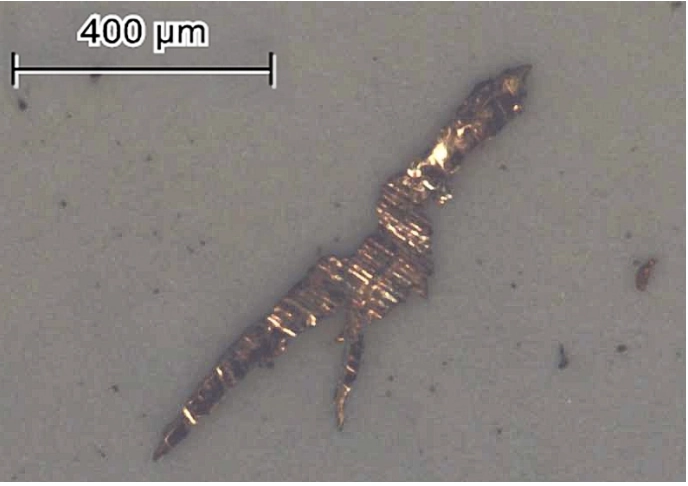

The ISO 16232 standard covers:
Types of extraction methods (spray, ultrasound, rinsing, combination)
Operating parameters (pressure, duration, temperature)
Filtration procedures
Particle analysis: number, size, type (metallic, non-metallic, fibers)
Interpretation of results according to the type of component

On a drawing or in a specification, the cleanliness requirement usually appears as a compact code: the CCC (Component Cleanliness Code). Let’s take a real specification and decode it segment by segment.
The letter before the parenthesis tells you what the numbers refer to. Without it, the code cannot be interpreted.
| Letter | Values are expressed… |
|---|---|
| A | per 1,000 cm² of wetted surface (our example) |
| V | per 100 cm³ of wetted volume (circuits, tanks) |
| N | per part, as an absolute number of particles (not a level) |
Each letter is a size class. A hyphen joins adjacent classes that share a single limit: F-G10 means the sum of F + G particles must not exceed level 10. Classes that do not appear in the code (here B, C and D) have no requirement.
The number after the letter is not a count: it is a contamination level. The standard defines 26 levels, from 00 to 24; each level roughly doubles the previous one, so a few units of difference mean a lot.
Level 00 is special: it means zero particles, with no tolerance. The highlighted levels are the ones in our example.
| Level | Particles per 1,000 cm² | Example |
|---|---|---|
| 00 | 0 | J-K |
| 0 | > 0 to 1 | — |
| 1 | > 1 to 2 | — |
| 2 | > 2 to 4 | — |
| 3 | > 4 to 8 | — |
| 4 | > 8 to 16 | H-I |
| 5 | > 16 to 32 | — |
| 6 | > 32 to 64 | — |
| 7 | > 64 to 130 | — |
| 8 | > 130 to 250 | — |
| 9 | > 250 to 500 | — |
| 10 | > 500 to 1,000 | F-G |
| 11 | > 1,000 to 2,000 | — |
| Level | Particles per 1,000 cm² | Example |
|---|---|---|
| 12 | > 2,000 to 4,000 | — |
| 13 | > 4,000 to 8,000 | — |
| 14 | > 8,000 to 16,000 | — |
| 15 | > 16,000 to 32,000 | E |
| 16 | > 32,000 to 64,000 | — |
| 17 | > 64,000 to 130,000 | — |
| 18 | > 130,000 to 250,000 | — |
| 19 | > 250,000 to 500,000 | — |
| 20 | > 500,000 to 1,000,000 | — |
| 21 | > 1 M to 2 M | — |
| 22 | > 2 M to 4 M | — |
| 23 | > 4 M to 8 M | — |
| 24 | > 8 M to 16 M | — |
M = million. The upper limit of each level is included (e.g. level 10: more than 500 and up to 1,000 particles).
A housing with 2,500 cm² of wetted surface is analyzed according to ISO 16232. The lab counts particles on the whole part; since the code is in “A”, the counts are divided by 2.5 to bring them to 1,000 cm².
| Criterion | Size | Counted on the part | ÷ 2.5 → per 1,000 cm² | Limit | Result |
|---|---|---|---|---|---|
| B–D | 5–50 µm | reported | — | no limit | Informative |
| E15 | 50–100 µm | 41,500 | 16,600 | ≤ 32,000 | Compliant |
| F-G10 | 100–200 µm | 1,820 + 410 = 2,230 | 892 | ≤ 1,000 | Compliant (borderline) |
| H-I4 | 200–600 µm | 27 + 6 = 33 | 13.2 | ≤ 16 | Compliant |
| J-K00 | 600–1,500 µm | 1 + 0 = 1 (640 µm burr) | 0.4 | 0 | Non-compliant |
Our systems are designed from the outset to comply with these standards:
Machine design compatible with ISO/VDA controls
Particle separation through fine filtration
Monitoring of critical process parameters (pressure, temperature, timing)
Pre-process validation in the laboratory.
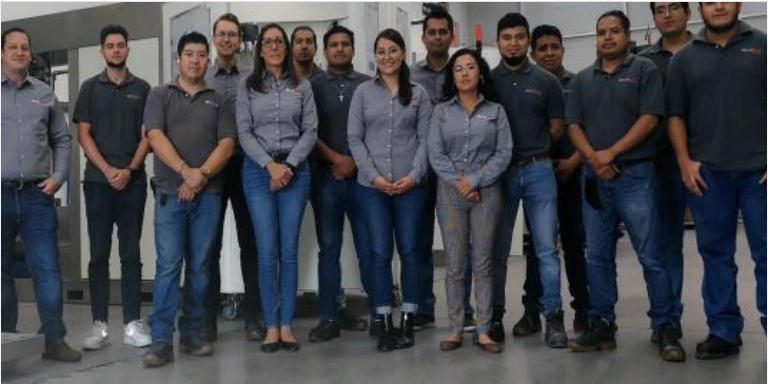
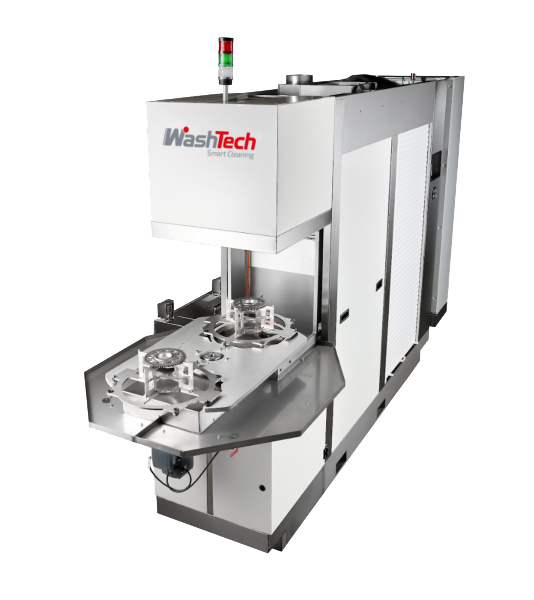
At WashTech, we design and manufacture equipment specifically engineered to meet precise cleanliness criteria.
High-precision rotary spray machines
Immersion and ultrasonic systems for extreme criteria
Fine filtration
Pre-process validation with internal testing
Equipment compatible with ISO 16232 / VDA 19.1
Free advice from our engineers and washing trials with your own parts, in Mexico or France.
